

At the end of the 19th Century, in Australia, a promising young actor named Frederick Matthias Alexander began to experience a career-threatening problem: he lost his voice every time he got up on stage. The doctors of the time didn’t manage to find the cause, nor could they offer a suitable solution. Convinced that the source of his problem lay in the way in which he acted and recited on stage, Alexander decided to investigate for himself.
Standing in front of a mirror, he began to carefully observe what he did with his body while he recited. He discovered that, without realizing, he brought his head back and down, compressed his larynx and shortened his stature. The most surprising thing was that he did not have the slightest sensation that he was doing this: what he felt internally did not coincide with what he saw in the mirror. (Most of us have certainly had the experience of seeing a photo or video of ourselves and noticing that our posture or mannerisms are different to what we expected).
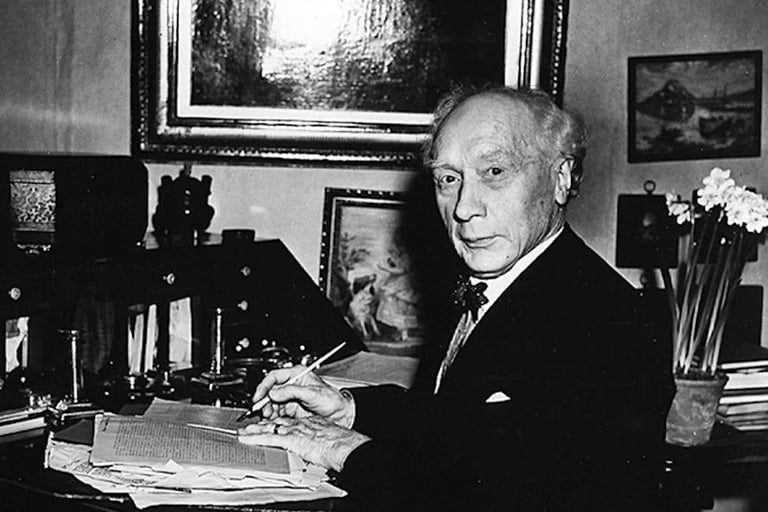
Who was F. M. Alexander?
So Alexander decided to recite without performing these movements that he had observed, but as much as he tried to stop doing them, at the moment when he began to speak he tensed up automatically once again. Fortunately, he was an especially patient man and spent months experimenting and searching for a way in which to recite without his habitual tension.
Finally, he managed to solve the problem with his voice. How did he do it? It is rather too lengthy to explain here, but in short, he realized he needed to change the way in which he recited. He discovered that the solution was not to apply extra muscular effort to correct himself, but to stop trying to do too much and to pay attention to his entire body, prioritizing allowing his neck to be free.
Once he had solved his problem, Alexander began to give voice classes, applying these principles and using his hands to guide his students, such that it was much easier for them to change than it had been for him. His students reported that, as well as improving their voice issues, other issues such as chronic indigestion or depression were also solved, which led Alexander to understand that his discoveries had far-reaching implications. In 1904, he emigrated to London, where he received the support of doctors and scientists, and counted John Dewey, Aldous Huxley and George Bernard Shaw among his students. He lived there until his death in 1955.
Nowadays, there are thousands of certified teachers around the world, and people seek us out to help solve issues caused by muscular tension and poor posture. In Mexico we still have a relatively small number of teachers because until January 2016 (when the country’s first training school opened) it was necessary to travel abroad to become certified.
Mexican Association of Alexander Technique Teachers (APTAM)
© 2026. All rights reserved. APTAM